EN
 AR
 BG
 HR
 CS
 NL
 FI
 FR
 DE
 EL
 HI
 IT
 JA
 KO
 NO
 PL
 PT
 RO
 RU
 ES
 TL
 IW
 ID
 VI
 HU
 TH
 TR
 FA
 MS
 UR
 HA
 JW
 LA
 MY
 KK
 TG
 UZ
 AM
 PS

Why 7/16 DIN Connectors Remain the Industry Standard for High-Power RF and Low-PIM Applications
7/16 DIN connectors deliver high power handling, ultra-low PIM and IP-rated weatherproof performance for base stations, broadcast transmitters, DAS and antenna systems. Explore specifications, applications and OEM assembly services. Request a quote today.
In an era of ever-smaller RF components, one connector has refused to be downsized—and for good reason. The 7/16 DIN coaxial connector, with its robust threaded coupling and large contact surfaces, remains the default choice wherever high power, low passive intermodulation (PIM) and long-term outdoor reliability matter more than miniaturisation.
Originally developed in Germany and standardised as the DIN 47223 interface, the 7/16 (referring to the 7 mm inner and 16 mm outer conductor dimensions) is now specified by major telecom operators, broadcast engineers and antenna manufacturers worldwide. It is the workhorse behind cellular base stations, FM/TV broadcast links, distributed antenna systems (DAS), microwave links and weather radar installations.
What Is a 7/16 DIN Connector?
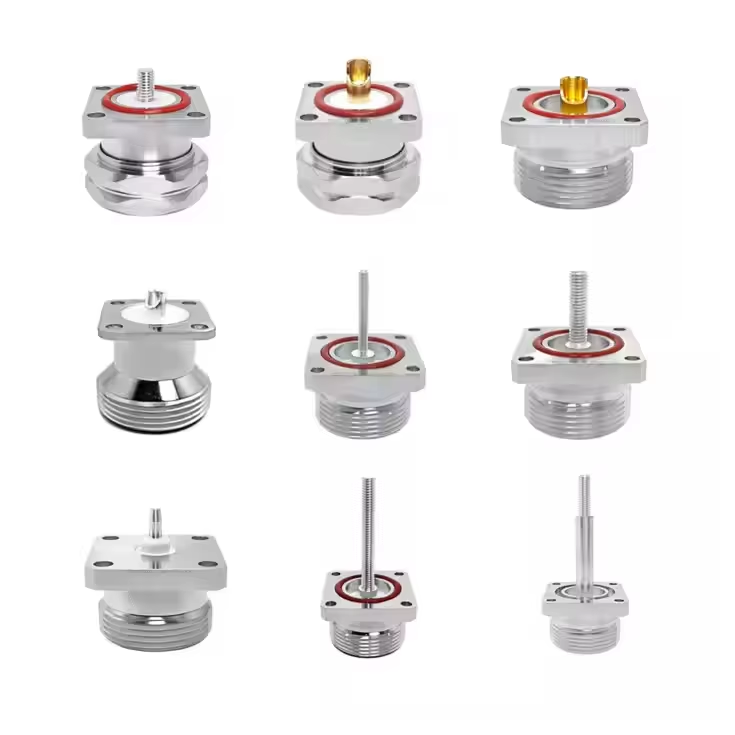
The 7/16 DIN is a 50 Ω threaded RF connector designed primarily for semi-rigid or corrugated coaxial cables such as 1/2", 7/8" and 1-5/8" feeder cables. Its defining features are a large contact area, self-flushing thread design that wipes contamination during mating, and a structure engineered to minimise PIM generation under high-power conditions.
Typical electrical and mechanical characteristics include
|
Impedance |
50 Ω |
|
Frequency range |
DC–3 GHz (standard); extended versions up to 6 GHz / 7.5 GHz for specialised applications |
|
PIM performance |
≤ −150 dBc typical; ≤ −160 dBc achievable on premium low-PIM versions (2 × 43 dBm test) |
|
Power handling |
several kW at UHF bands (e.g., ~5 kW @ 900 MHz on 7/8" cable), depending on cable and frequency |
|
VSWR |
1.10 max typical; 1.05 or better on precision grades |
|
Rated voltage |
~5 kV RMS (depends on cable) |
|
Contact resistance |
centre ≤ 1 mΩ; outer ≤ 0.5 mΩ (typical design targets) |
|
Insulation resistance |
≥ 5 GΩ |
|
Coupling |
threaded 7/16-28 UNEF, torque-controlled mating |
|
Environmental protection |
IP67/IP68 when properly mated and sealed; operating temperature typically −40 °C to +85 °C (up to +125 °C for selected designs) |
|
Materials |
brass or bronze body, silver or tri-metal plating, PTFE dielectric; stainless steel options for harsh environments |
|
Durability |
hundreds of mating cycles; designed for field serviceability |
Note: figures above are representative of the 7/16 DIN family. Confirm exact values against the datasheet and the applicable standard (IEC 61169-4 / DIN 47223).
Why 7/16 DIN Still Wins in Macro Networks
1. Passive intermodulation matters more than ever. As operators densify networks and stack multiple carriers—LTE combined with 5G NR in the same band—any non-linear junction in the RF path creates intermodulation products that raise the noise floor and degrade throughput. The 7/16 DIN's large, stable contact interface and controlled mating torque make it one of the lowest-PIM interfaces available in mass production.
2. Power handling scales with size. For broadcast transmitters and high-power feeder systems, smaller connectors simply cannot dissipate the heat. The 7/16 DIN's generous conductor cross-section keeps insertion loss low and power capacity high, especially when paired with 7/8" and 1-5/8" cables.
3. Built for the tower, not the lab. Threaded coupling resists accidental disconnection, wind-induced vibration and thermal cycling. With proper sealing, the interface survives years of exposure to rain, ice and salt spray—something push-on miniature connectors cannot promise.
Common Configurations and Variants
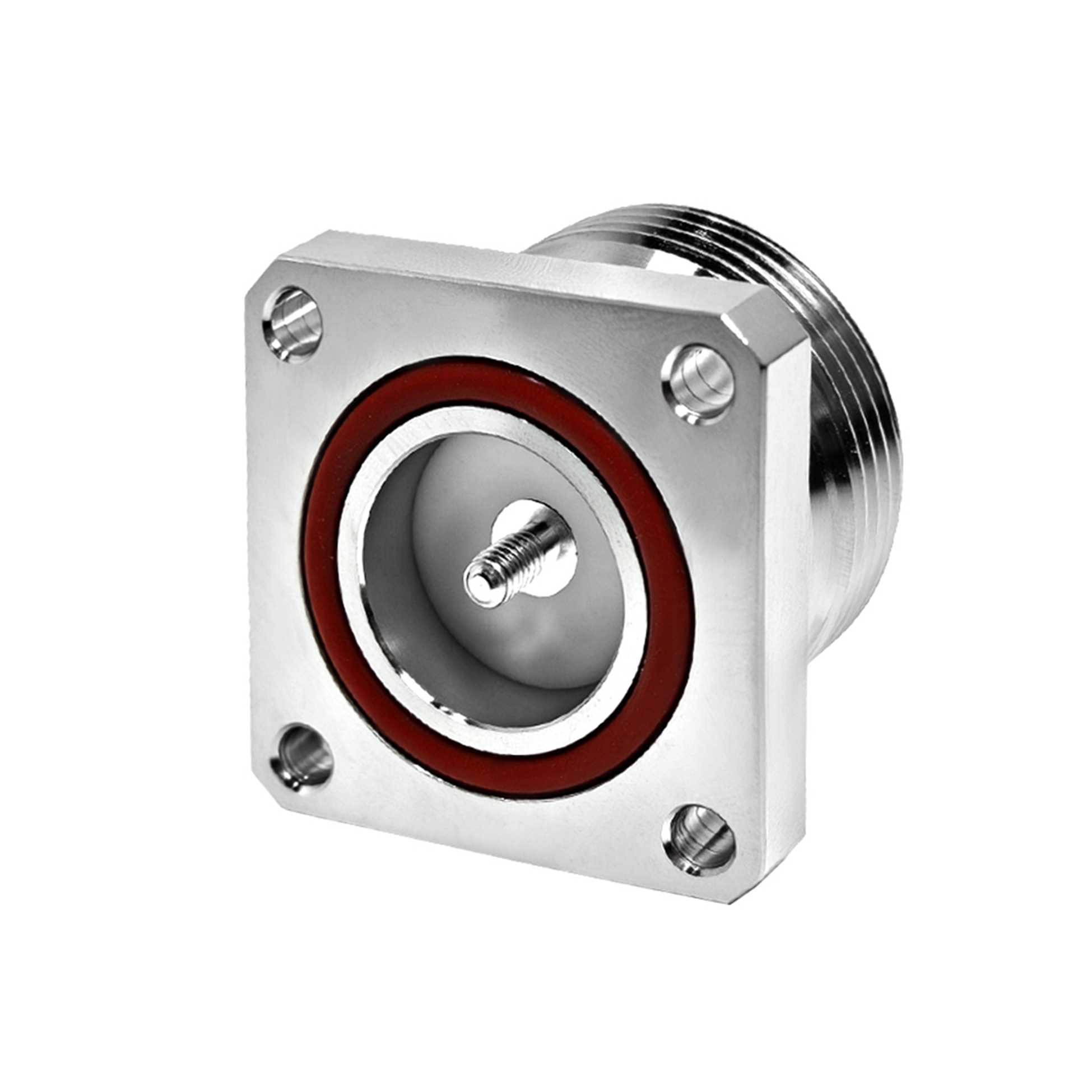
|
Type |
Typical Use |
|
Straight plug (male/female) |
Jumper to antenna, feeder termination |
|
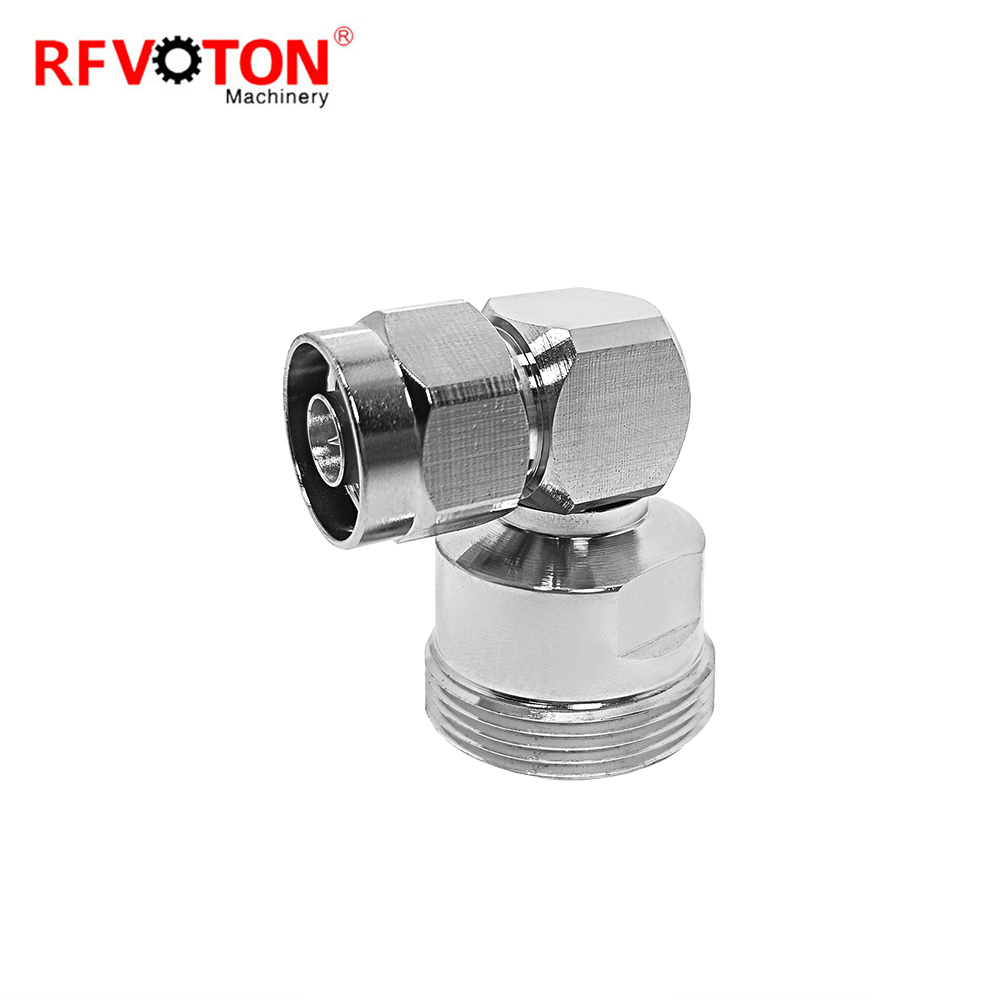
Right-angle plug |
Tight cabinet spaces, patch panels |
|
Bulkhead/jack receptacle |
Equipment panels, combiner outputs |
|
Fixed attenuator / load terminations |
Test and commissioning |
|
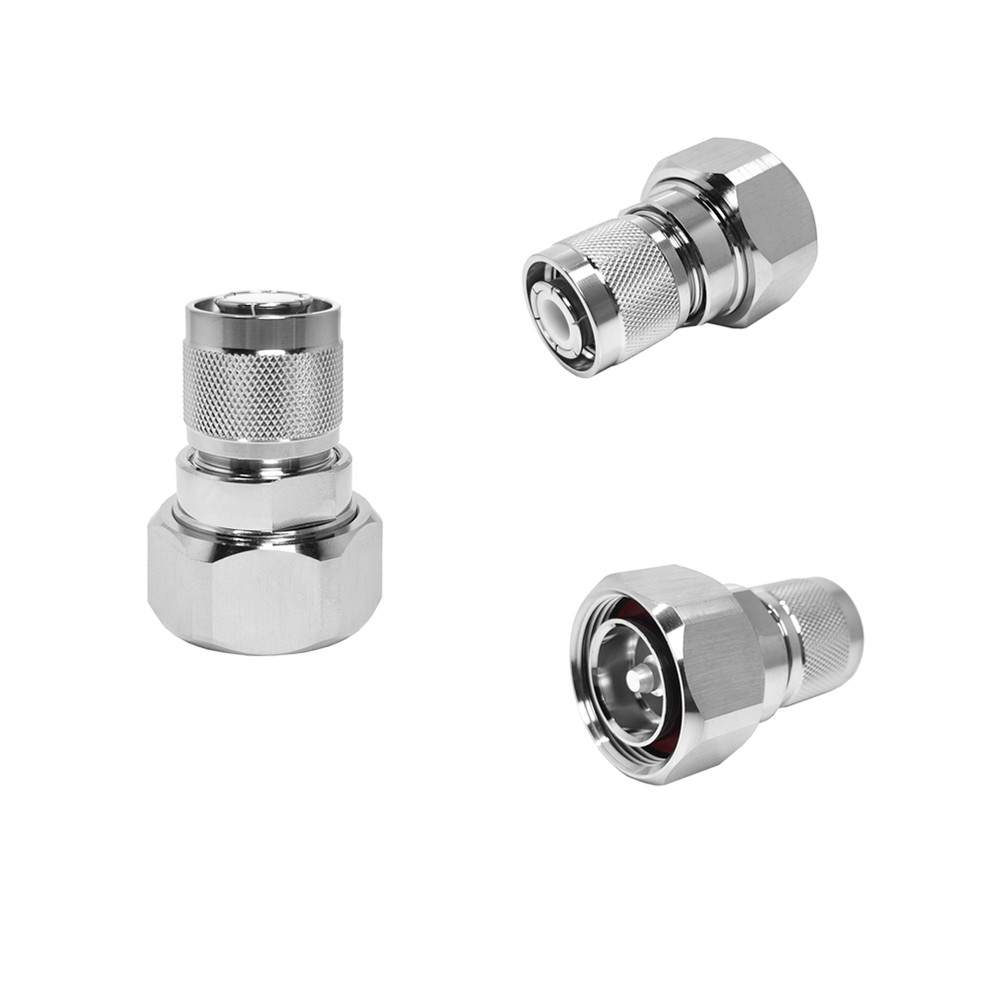
Adapter: 7/16 DIN ↔ N-type, 4.3-10, DIN 7/16 female-male |
Mixed-interface sites, legacy migration |
|
Low-PIM jumper assemblies |
BTS-to-antenna runs, indoor DAS trunks |
|
Grounding kits & weatherproofing accessories |
Tower installation |
The rise of 4.3-10 as a companion. In many new macro-cell deployments, the smaller 4.3-10 connector is replacing 7/16 DIN at the antenna port to save space and weight, while 7/16 DIN remains dominant in the feeder, combiner and equipment room. This hybrid approach has actually increased demand for high-quality 7/16 DIN-to-4.3-10 adapters and jumpers—a segment worth watching closely.
Where 7/16 DIN Is Used
- Cellular base stations (2G/3G/4G/5G sub-6): feeder jumpers, combiner outputs, TMA connections
- FM radio and DVB-T/T2 broadcast transmitters: high-power feed lines
- DAS and in-building coverage: main trunk lines and head-end interconnects
- Microwave and point-to-point links: outdoor unit interfaces
- Weather radar, satellite ground stations and defence communications
- Test and measurement: high-power load terminations and calibration paths
What Buyers Should Check Before Ordering
Because 7/16 DIN parts look similar but perform very differently under load, procurement teams should verify:
- PIM rating and test conditions — confirm the reported dBc value, the test power (e.g., 2 × 43 dBm), and whether testing follows IEC 62037. A "low PIM" claim without a test method is not meaningful.
- Plating quality — silver plating offers excellent conductivity but tarnishes; tri-metal or carefully specified silver plating with proper passivation improves long-term PIM stability. Avoid cheap bright-plated finishes in outdoor service.
- Cable compatibility — match the connector to the exact cable type and O.D. (1/2", 7/8", 1-5/8" corrugated copper or foam-dielectric). A mismatched clamp ruins both VSWR and PIM.
- Torque specification — always use a calibrated torque wrench at installation; under-torque causes PIM drift, over-torque damages threads.
- Waterproofing method — specify heat-shrink, self-amalgamating tape or moulded boots, and require IP verification.
- Material certification — brass body vs. stainless steel for coastal or chemical environments.
- Compliance documentation — RoHS/REACH, IEC 61169-4 conformance, and batch-level test reports for VSWR/PIM.
- Interchangeability — genuine 7/16 DIN is dimensionally standardised across manufacturers, but tolerance stacking on low-cost parts can cause hard mating or galling.
Assembly, Testing and Export Services
We supply both standalone 7/16 DIN connectors and fully assembled low-PIM jumper cables, cut to length and tested before dispatch. Typical capabilities include:
- Custom lengths with 7/16 DIN, N-type, 4.3-10 or EIA flange on the opposite end
- Individual PIM and VSWR test reports per serial/batch number
- Heat-shrink booting and colour-coding by sector or band
- Reel or carton packing; bulk connectors supplied loose or in boxes
- Lead times: popular configurations from stock; custom assemblies quoted by drawing
- Commercial terms: FOB / CIF / DDP; air or sea freight; sample lots accepted
A Word from Our Engineering Team
"In a high-power RF path, the connector is not a commodity—it's a potential source of distortion. A 7/16 DIN that measures perfectly on day one but drifts after six months on a tower costs far more than the price difference between suppliers. We build and test for long-term stability, not just pass-fail at shipment."
About Us
We are a China-based manufacturer and exporter of RF connectors and coaxial cable assemblies, supplying telecom operators, antenna makers, broadcast integrators and EMS partners across Europe, the Middle East, Southeast Asia and the Americas. Our product range covers 7/16 DIN, 4.3-10, N-type, SMA, DIN 7/16 adapters, low-PIM jumper assemblies and custom RF solutions. OEM and ODM orders are welcome.
Hot News
-
Unlocking the "Precision Eye" of Phased Array Radar: The Ultimate Craftsmanship of Phase-Matched Cable Assemblies
2026-09-04
-
SMC Coaxial Connectors
2026-08-23
-
What is RF coaxial connector? What are the characteristics and applications?
2025-07-01
-
BNC Connector
2024-07-22
-
SMA connector
2024-07-19
-
The difference between BNC connectors and SMA connectors
2024-07-03
-
What are the advantages of anti-interference coaxial cables
2023-12-18
-
Complete Guide to Basic Knowledge of Coaxial Connectors
2023-12-18
-
Why is the anti-interference ability of coaxial cables so strong
2023-12-18